
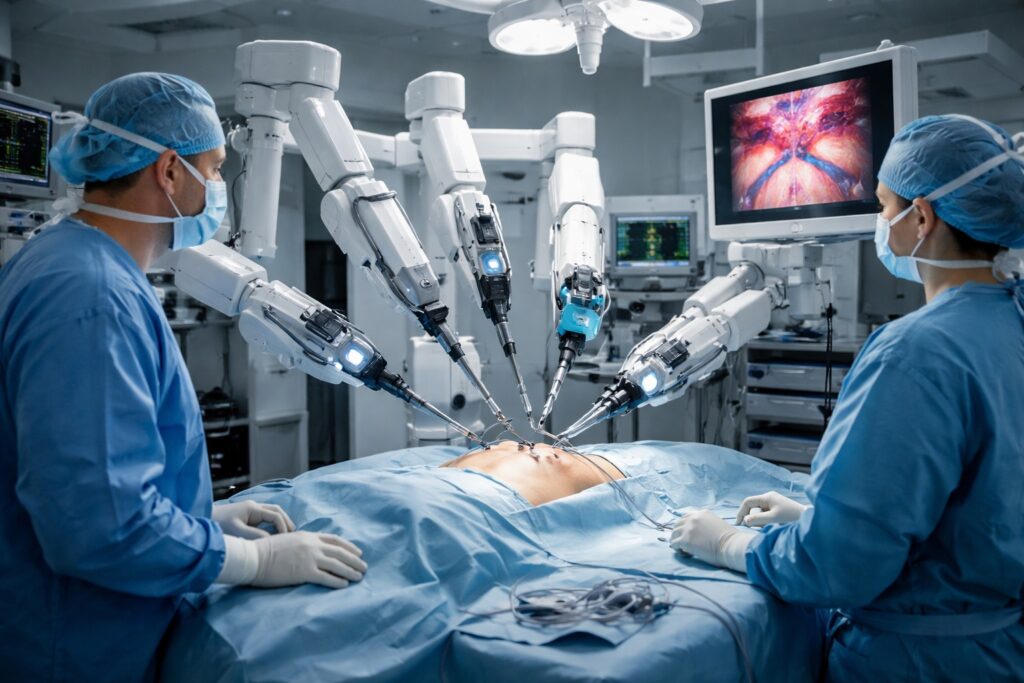
Robotic surgery is one of the most important developments in medical technology, which has drastically changed healthcare. This cutting-edge surgical technique offers increased accuracy, safety, and efficiency by fusing the knowledge of talented surgeons with cutting-edge robotic equipment. Compared to conventional surgical techniques, patients are seeing better results and quicker recovery times as hospitals all over the world implement this technology.
What Is Robotic Surgery?
Robotic surgery is a minimally invasive surgical method in which doctors employ a robotic machine to carry out intricate procedures with improved precision and control. A surgeon’s workstation, a high-definition 3D camera, and robotic arms are all part of the system. The robot accurately converts the surgeon’s hand movements into smaller, more controlled movements inside the patient’s body, even though it cannot function on its own.
With fewer incisions, this sophisticated technique enables surgeons to reach difficult-to-reach regions, minimizing tissue damage and enhancing overall surgical accuracy.

How Robotic Surgery Works
Sitting at a console, the surgeon uses an enlarged 3D display to see the surgical region during the surgery. In order to eliminate hand tremors and enable incredibly delicate manipulations, the robotic arms mimic the surgeon’s actions in real time. For intricate surgeries involving sensitive organs, nerves, or blood vessels, this degree of control is especially helpful.
Surgeons may now carry out surgeries that were previously difficult with traditional methods thanks to robotic equipment’ improved visibility and flexibility.
Key Benefits for Patients
One of the biggest advantages of robotic surgery is its patient-centered benefits. Smaller incisions result in less blood loss, reduced pain, and minimal scarring. Patients often experience shorter hospital stays and faster recovery, allowing them to return to daily activities sooner.
Furthermore, the accuracy provided by robotic-assisted treatments reduces the chance of infections and consequences. Both patients and healthcare professionals are choosing it more and more because of these advantages.
Medical Fields Using Robotic Surgery
This cutting-edge surgical technique is frequently employed in many different medical fields. It is frequently used in urology for kidney and prostate treatments. It is used in general surgery for colorectal procedures and hernia repair, and in gynecology for hysterectomies and fibroid removal.
In cardiothoracic, orthopedic, and cancer-related treatments, where precision and minimal invasiveness are essential for optimal results, robotic surgery is likewise becoming more and more common.
Robotic Surgery vs Traditional Surgery
Robotic-assisted procedures provide better visibility and greater precision than open surgery. Robotic devices offer a greater range of motion comparable to the human wrist, in contrast to laparoscopy, which has restricted tool movement. Surgeons can execute complex procedures with more assurance and reliability thanks to this flexibility.
Robotic surgery frequently results in improved postoperative comfort and faster healing for qualified patients, even if traditional surgery is still successful in many situations.
Safety and Surgeon Expertise
In robotically assisted treatments, safety is of utmost importance. Before performing these procedures, surgeons must complete rigorous training and certification. To guarantee dependable operation throughout the process, the robotic systems are built with several safety checks and backup devices.
Robotic surgery has shown itself to be a safe and successful solution for numerous complicated medical issues when done by skilled surgeons and with careful patient selection.
The Future of Robotic Surgery
Robotic surgical systems are getting more sophisticated, available, and effective as technology develops. It is anticipated that advancements in robots, imaging, and artificial intelligence would significantly improve surgical precision and patient outcomes.
The increasing usage of robotic surgery is indicative of its potential to transform contemporary healthcare by providing patient-centered, precision-driven treatment options.
Conclusion
Robotic surgery, which combines human skill with state-of-the-art technology, is a significant advancement in medical care. It is changing the way complicated surgeries are carried out with advantages like less discomfort, quicker recovery, and increased accuracy. Robotic-assisted surgeries will continue to be essential to providing safer and more efficient healthcare globally as medical innovation advances.
Authored By: Rumaisa k & Neha Fathima