
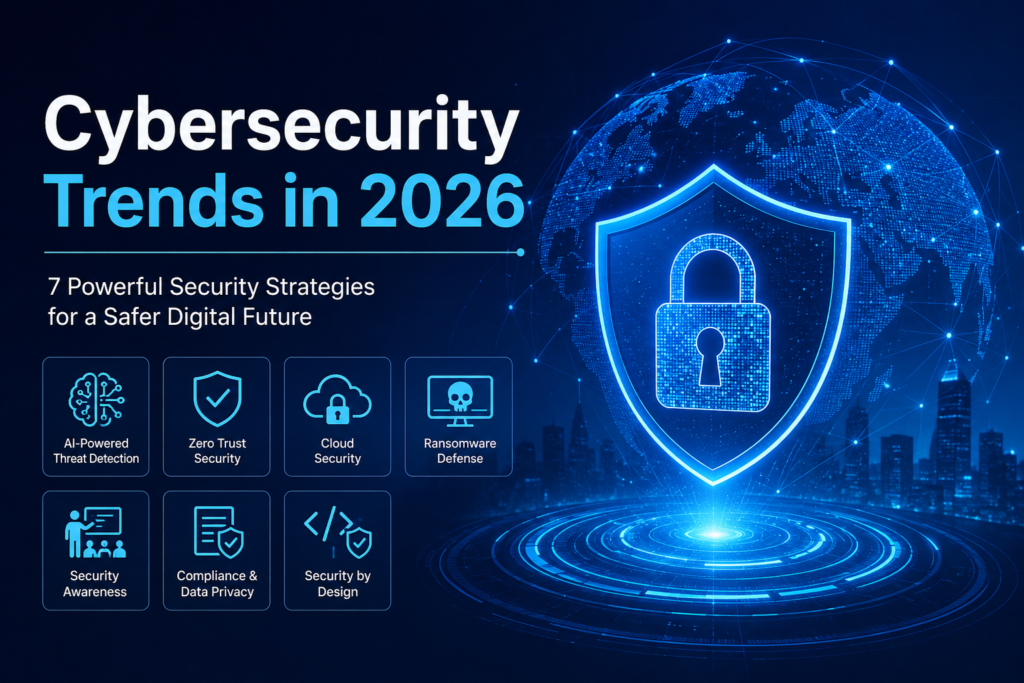
As digital technologies continue to evolve, businesses and individuals face increasingly sophisticated online threats. Cybersecurity Trends in 2026 are shaping how organizations protect sensitive information, maintain customer trust, and secure business operations. From artificial intelligence to stronger identity protection, cybersecurity is becoming a strategic business priority rather than just a technical requirement.
Understanding these changes early can help organizations strengthen security frameworks and prepare for future digital challenges.
1. AI-Driven Threat Detection Will Become More Advanced

Artificial intelligence is expected to play a larger role in cybersecurity operations. Security platforms are becoming smarter at detecting unusual patterns and identifying threats before they cause damage.
AI-powered monitoring can process large amounts of data quickly and improve response times. Among the most important Cybersecurity Trends in 2026, automated security systems will help organizations reduce manual workloads while increasing protection.
2. Zero Trust Security Models Will Continue Growing
Zero Trust remains one of the strongest approaches to modern security.
This model follows the principle of continuously verifying users, devices, and access requests instead of automatically trusting internal networks. Organizations are implementing stronger identity controls to reduce exposure to cyber threats.
Businesses adopting Zero Trust can create more secure environments for employees, customers, and digital assets.
3. Cloud Security Will Receive Increased Investment
Cloud technology offers flexibility and scalability, but it also introduces additional security responsibilities.
Companies are focusing on:
- Multi-factor authentication
- Cloud access controls
- Data encryption
- Continuous monitoring
- Secure configurations
These improvements support stronger protection across cloud platforms and reduce operational risks.
4. Ransomware Defense Will Shift Toward Prevention
Ransomware continues to be one of the most disruptive forms of cyberattack.
Organizations are moving beyond recovery strategies and focusing more on prevention through employee awareness, stronger backups, and rapid incident response planning.
One of the major Cybersecurity Trends in 2026 is the shift toward proactive protection instead of reacting after attacks occur.
5. Human-Centered Cybersecurity Training Will Expand
Technology alone cannot eliminate cyber threats.
Employees often become the first line of defense against phishing attempts and social engineering attacks. Continuous security education and practical training programs help teams identify risks earlier and respond more effectively.
Businesses are increasingly integrating cybersecurity awareness into everyday operations.
6. Compliance and Data Privacy Will Become Stronger
Data protection regulations continue evolving worldwide.
Organizations are placing greater importance on security policies, documentation, privacy controls, and compliance management. Building trust through transparent data handling practices is becoming a competitive advantage.
Businesses that prioritize regulatory readiness may improve long-term operational stability.
7. Security by Design Will Influence Development
Organizations are embedding security practices directly into product and system development.
Instead of addressing vulnerabilities after launch, businesses are integrating secure coding, testing, and risk management from the beginning.
This approach supports safer digital experiences and reduces future security costs.
Preparing for the Future of Cybersecurity

The digital landscape is changing rapidly, and businesses must adapt to stay protected. Cybersecurity Trends in 2026 show that successful organizations will combine advanced technology, employee education, proactive planning, and continuous improvement.
Companies that prepare early can strengthen resilience, reduce security incidents, and create greater trust with customers and stakeholders. Building a strong cybersecurity culture, reviewing security policies regularly, and investing in modern protective technologies can create long-term advantages in an increasingly connected world.
Summary
The future of cybersecurity will focus on intelligent threat detection, stronger identity controls, cloud protection, proactive defense, employee awareness, and security-first development. Following Cybersecurity Trends in 2026 allows organizations to stay prepared, improve digital resilience, and build safer business environments for long-term growth.
As cyber risks continue to evolve, organizations that remain informed and responsive will be better positioned to protect valuable data and maintain customer confidence. Developing adaptable cybersecurity strategies today can support stronger business performance and sustainable digital success in the years ahead.
Written by: Rana Abdurahiman