
Artificial intelligence (AI) is transforming the way people live, communicate and work. From automated customer service to advanced healthcare systems, AI is becoming an essential part of modern industries. However, one question continues to create concern among professionals and students: Will Artificial Intelligence Replace Human Jobs? While AI offers numerous benefits, it also raises important questions about employment, job security and the future of human workers.
Understanding the Rise of Artificial Intelligence
Artificial intelligence refers to technology that enables machines to perform tasks that traditionally require human intelligence. These tasks include problem-solving, decision-making, language processing and data analysis.
Businesses increasingly use AI to improve productivity, reduce operational costs and complete tasks efficiently. Industries such as banking, healthcare, manufacturing, education and retail are adopting AI-powered solutions to simplify their daily operations.
As technology continues to advance, employees must understand how these developments could influence their career opportunities.
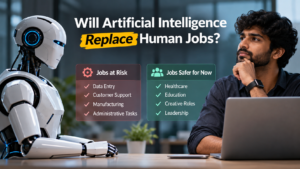
Will Artificial Intelligence Replace Human Jobs?
AI has the potential to replace certain jobs, particularly those involving repetitive and predictable tasks. Machines can process large amounts of information quickly and perform routine activities with minimal human intervention.
Some jobs that may be significantly affected include:
- Data entry operators
- Customer service representatives
- Factory and assembly line workers
- Cashiers and billing operators
- Administrative assistants
However, automating individual tasks does not necessarily mean eliminating entire professions. Many businesses are using artificial intelligence to support employees rather than completely replace them.
Jobs That Are Less Likely to Be Replaced by AI
Despite its advanced capabilities, artificial intelligence has limitations. Human creativity, emotional intelligence, empathy and complex decision-making remain difficult for machines to replicate fully.
Professions that depend heavily on these qualities include:
- Doctors and healthcare professionals
- Teachers and educators
- Psychologists and counsellors
- Creative designers and artists
- Entrepreneurs and business leaders
These professionals can use AI to improve their performance while maintaining the human connection required in their respective fields.
How AI Is Creating New Job Opportunities
When people ask, Will Artificial Intelligence Replace Human Jobs?, they often overlook the employment opportunities created by technological advancement.
The growth of artificial intelligence is generating demand for professionals in emerging fields such as:
- AI engineering
- Machine learning
- Data science
- Cybersecurity
- AI ethics and governance
- Robotics engineering
Businesses also need skilled individuals who can manage, monitor and effectively implement AI technologies. Although some traditional roles may decline, new career paths are emerging as industries adapt to technological changes.
The Impact of AI on the Future Workforce
Artificial intelligence is changing the skills employers expect from their workforce. Technical knowledge alone may not be enough to remain competitive in an increasingly automated environment.
Employees must develop critical thinking, adaptability, communication and problem-solving abilities. Learning how to work alongside AI tools can also improve productivity and professional efficiency.
Educational institutions and organisations have an important responsibility to provide training programmes that prepare individuals for these changes.
How to Protect Your Career in the AI Era
Instead of constantly worrying about the question, Will Artificial Intelligence Replace Human Jobs?, individuals should focus on preparing themselves for the future.
Here are some practical ways to remain competitive:
- Develop AI literacy and technical skills.
- Improve creativity and critical thinking.
- Learn to use AI-powered tools effectively.
- Strengthen communication and leadership abilities.
- Stay updated with emerging industry trends.
- Invest in continuous learning and professional development.
Adapting to technological changes can help individuals discover new opportunities and build more resilient careers.
Conclusion
So, Will Artificial Intelligence Replace Human Jobs? The answer depends on the industry, profession and ability of individuals to adapt. While AI may replace certain repetitive roles, it can also create new opportunities and improve workplace efficiency.
The future of employment is likely to involve collaboration between humans and artificial intelligence. By developing relevant skills, embracing innovation and continuously learning, individuals can prepare themselves for an evolving job market.