
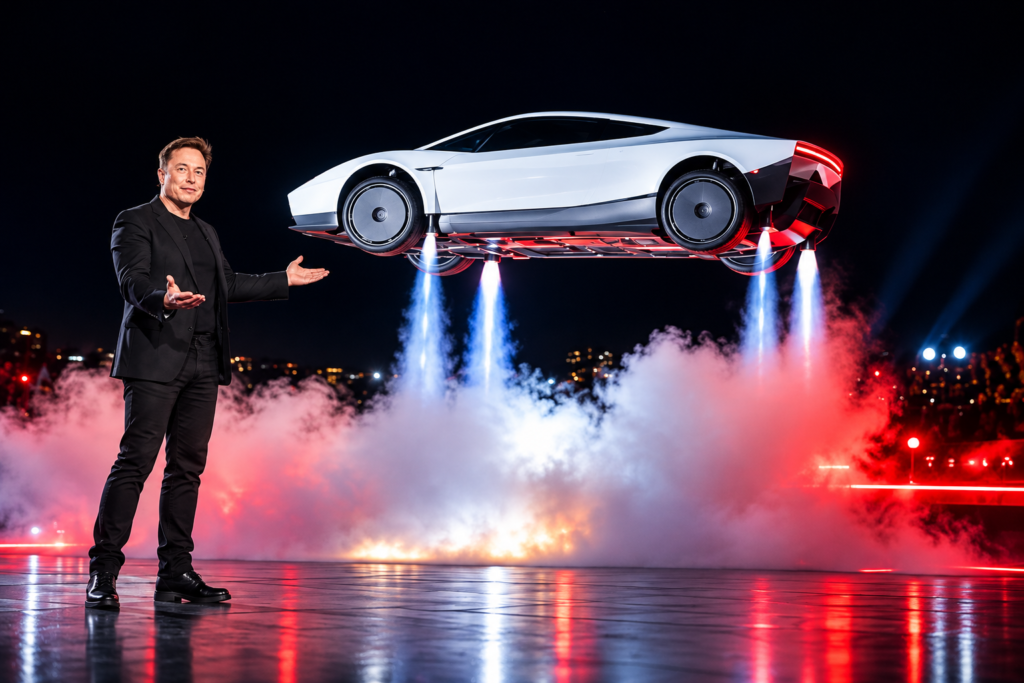

Tesla Flying Car is an exciting development that has attracted attention from automobile enthusiasts and technology lovers worldwide. Imagine travelling above traffic instead of waiting in long queues on busy roads. What once seemed like science fiction is now being explored through advanced automotive and aerospace engineering. Tesla’s latest Roadster demonstration has brought this futuristic idea closer to reality, raising questions about how flying vehicles could change transportation.
What Is The New Tesla Flying Car?
Tesla’s latest flying-car concept is connected to its next-generation Roadster, an electric sports car featuring rocket-inspired technology developed with SpaceX engineering concepts.
In October 2026, Tesla demonstrated a Roadster prototype at a SpaceX facility in Texas. The vehicle drove up a curved ramp, briefly lifted into the air, performed a midair flip and landed. The demonstration attracted worldwide attention.
According to Tesla’s official Roadster website, the exclusive Rocket configuration includes cold-gas thrusters that support upward, forward and rotational movement. However, Tesla states that this version is not approved for public-road use.
How Does the Tesla Flying Car Technology Work?
One of the most interesting aspects of the Tesla Flying Car concept is its combination of automotive engineering and aerospace technology.
Here are some important features:
Cold-gas thrusters: These systems provide controlled bursts of thrust to support aerial movement.
Electric actuators: They help control the movement and positioning of the thrusters.
Advanced aerodynamics: Special aerodynamic features help improve vehicle stability and performance.
Multi-mode suction system: Powered fans and a sealing system are designed to generate additional grip and downforce.
These technologies demonstrate how ideas from the automotive and aerospace industries can work together to create innovative transportation concepts.
What Makes This Innovation Different?
Traditional electric vehicles focus on improving road performance, battery efficiency and driving comfort. However, the new Roadster concept introduces an entirely different dimension.
Its rocket-assisted capabilities could make it one of the most unusual sports cars ever demonstrated. Elon Musk has also claimed that the vehicle could accelerate from 0 to 60 mph in less than one second.
The combination of extreme acceleration, futuristic styling and aerial manoeuvres makes this project particularly interesting for automobile enthusiasts.
However, the demonstrated capabilities should not be confused with everyday flying transportation. The rocket-equipped version is not approved for public-road use, and the technology still faces significant practical challenges.
When Will It Be Available?
According to the October 2026 announcement, Tesla plans to begin Roadster production in 2028. However, the rocket-equipped flying system is described as an invitation-only offering rather than a standard feature available to ordinary customers.
Its availability will depend on engineering development, safety testing and regulatory approval. Therefore, interested buyers should not assume that the demonstrated flight capabilities will be available in the production model.
Challenges Facing Flying Cars
Despite the excitement surrounding the Tesla Flying Car concept, several challenges remain.
Safety: Flying vehicles require advanced systems to prevent accidents and protect passengers.
Regulations: Aviation authorities must establish clear rules for vehicles operating in the air.
Cost: Developing and maintaining advanced propulsion technology could make these vehicles extremely expensive.
Practicality: Noise, energy requirements, landing areas and weather conditions must also be considered.
Solving these problems will be essential before flying vehicles become practical transportation options.
Final Thoughts
The future of transportation is moving beyond traditional roads, and Tesla’s latest Roadster demonstration offers an exciting glimpse of what automotive engineering might achieve. Although it is too early to call it a practical flying car, the project highlights the possibilities of combining electric vehicle technology with aerospace innovation.
As technology continues to develop, the dream of travelling beyond traffic may become more realistic. Whether this vision becomes an everyday reality or remains a specialised automotive innovation, one thing is certain: the future of transportation is becoming more interesting than ever.
Technology is constantly changing the way businesses and industries operate. Discover more insights about Digital Marketing and Technology and explore how innovation is shaping the digital world.
Written by : Fathima Sana
Website : sanazubair.in