
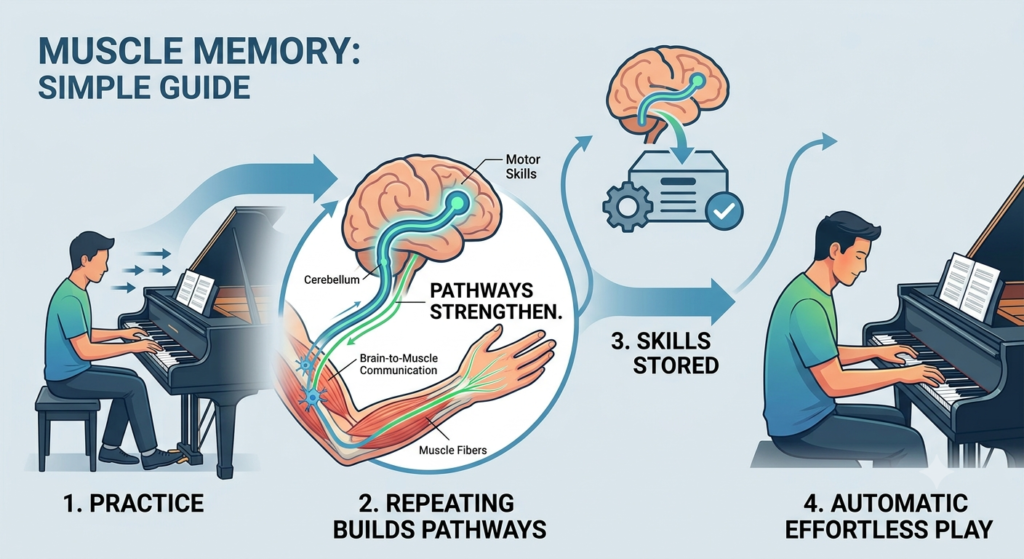
Understanding Muscle Memory and How It Works can help explain why some physical skills become easier and more natural after repeated practice. From riding a bicycle and typing to playing sports or performing exercises, familiar movements can eventually require less conscious thought. Although the term “muscle memory” suggests that muscles store memories, the process mainly involves the brain, nervous system, and repeated movement patterns.
What Is Muscle Memory?
Muscle memory describes the ability to perform a previously learned movement with greater ease and efficiency. When you practice a skill repeatedly, your nervous system becomes increasingly familiar with the sequence of movements involved.
For example, a basketball player who repeatedly practices shooting develops a consistent movement pattern. After enough practice, the player does not need to consciously think about every position of the hands, arms, and body. The movement becomes more automatic.
This is one reason repetition is so important when learning physical skills. Consistent practice gives the brain opportunities to refine coordination and timing.
Understanding Muscle Memory and How It Works
To understand muscle memory, it is useful to look at the relationship between the brain and muscles. Every physical movement involves communication between the brain, spinal cord, nerves, and muscles. When a movement is practiced repeatedly, the nervous system becomes more efficient at coordinating the required actions.
With practice, the brain can develop stronger and more efficient movement patterns. This allows familiar actions to be performed with less conscious attention. The result may be smoother, faster, and more coordinated movement.
However, muscle memory does not mean that muscles literally remember an action. Instead, it refers to adaptations involving the nervous system and, in some contexts, physical adaptations within muscle tissue that can contribute to the ability to regain performance after training.
How Practice Builds Muscle Memory
Repetition is one of the most important parts of developing a movement skill. However, quality matters as much as quantity. Repeating an incorrect technique can reinforce an inefficient movement pattern.
For this reason, beginners should focus on learning proper form before increasing speed or intensity. Coaches, teachers, and trainers can help identify mistakes and provide corrections during practice.
Short, consistent practice sessions can also be useful. Instead of performing a movement only occasionally, regular practice gives the nervous system more opportunities to reinforce the skill.
Muscle Memory in Sports
Sports provide many examples of this process. Football players practice passing, dribbling, and shooting. Tennis players repeat serves and strokes. Swimmers practice specific techniques until their movements become increasingly coordinated.
During competition, athletes often need to react quickly. Having practiced a movement many times can allow them to execute familiar skills without consciously analyzing every small movement.
This does not mean practice guarantees perfect performance. Fatigue, pressure, injuries, changing conditions, and other factors can influence how successfully a skill is performed.
Muscle Memory After a Break
People sometimes notice that a familiar skill returns quickly after a period without practice. Someone who learned to cycle as a child, for example, may still be able to ride after years away from a bicycle.
Similarly, people who have previously trained may regain certain aspects of their physical performance more quickly after returning to exercise. The speed and extent of this return vary between individuals and depend on factors such as previous training, time away, current fitness, and the skill involved.
How to Improve Movement Skills
Developing reliable movement patterns requires patience and consistency. Focus on correct technique, practice regularly, allow sufficient recovery, and gradually increase difficulty.
It is also helpful to pay attention to feedback. Recording practice sessions, working with a coach, or carefully observing technique can help identify areas that need improvement.
Conclusion
Understanding Muscle Memory and How It Works shows that repeated practice can help the nervous system become more efficient at familiar movements. Whether you are learning a sport, exercising, dancing, or developing another physical skill, consistent and correct practice can make movements smoother and more automatic over time.
Muscle memory is therefore not simply about muscles remembering actions. It is a combination of learning, nervous-system adaptation, coordination, and physical training that helps the body perform familiar movements more efficiently.
Written by: Farhan